
The Ofsted Science Subject Report Finding the optimum was published on 2nd February. It is an evaluation of the common strengths and weaknesses of science in 50 schools inspected by Ofsted and considers the challenges that science faces. The report uses the 2021 Ofsted science research review as a lens to evaluate practice, reinforcing the use of terminology to describe knowledge, and going further in terms of how assessment is described. You can find a useful summary of the research review (thanks to PSQM, ASE and SEERIH), and what this means for primary science here.
The content of the latest science subject report is interesting, but perhaps not surprising. Those who were at the ASE conference in Sheffield in January also had the opportunity to attend a pre-launch talk given by the incoming Chief HMI Eleanor Belfield. There is obviously a lot more detail in the report, but here’s a quick summary (I’m heartened that much of this was included in a CPD session I delivered last week and is underpinned by the work I do with organisations such as PSQM and STEM Learning to support teacher development):
- Curriculum goals need to be clearer with a focus on developing secure knowledge of science, not simply covering content, or activities.
- National Curriculum needs to be broken into clear steps – make clear the knowledge (substantive and disciplinary) that children will learn
- More consideration should be given to identifying and assessing the disciplinary knowledge, including concepts, that are needed to work scientifically; not just ‘doing practical work’.
- Disciplinary (how science works) should be intertwined throughout delivery of the substantive (content) knowledge.
- Vocabulary must be taught and used precisely
- Misconceptions must be addressed (this is a big focus) and taken account of in a clear progression model
- A range of pedagogy (teaching strategies) should be used – as appropriate to purpose and informed by research
- Assessment needs to check learning from previous years, not just at end of unit.
- Assessment for learning, using assessment to provide feedback, is important.
- Teachers need secure, relevant subject knowledge
- Importance of CPD
- Science needs to be given sufficient curriculum time and taught throughout the year
- Links to maths should be used to help learning in science
- Foundation stage science doesn’t always prepare children well enough for Y1
- Secondary schools should value primary science – in some it is ignored.
Artificial Intelligence – an aside
Something else which has been intriguing educators (and the rest of the world) in the last couple of months, is the rise of Artificial Intelligence (AI) generated content. The launch of ChatGPT at the end of last year has been causing hot debate about how content is created and the implications this might have for education (and beyond). The Twitter computing education live chat #CASchat is planning a special discussion on #ChatGPT and how it could reduce teaching workload, which could be a very interesting debate.
There are obvious limitations of computer-generated content, but AI has the capacity to learn and this open source platform seeks feedback to continuously improve.
I am excited and fearful in equal measure about how this will be used. As a curious scientist, I thought I would have a go and explore what it came up with in light of Ofsted’s recent science subject report. The more specific the question you ask, the more precise detail you get. At present it doesn’t know much about what has been happening in the world since 2021 so isn’t great for up-to-date information, but here are the results to my query, recent issues in primary science education in the UK:
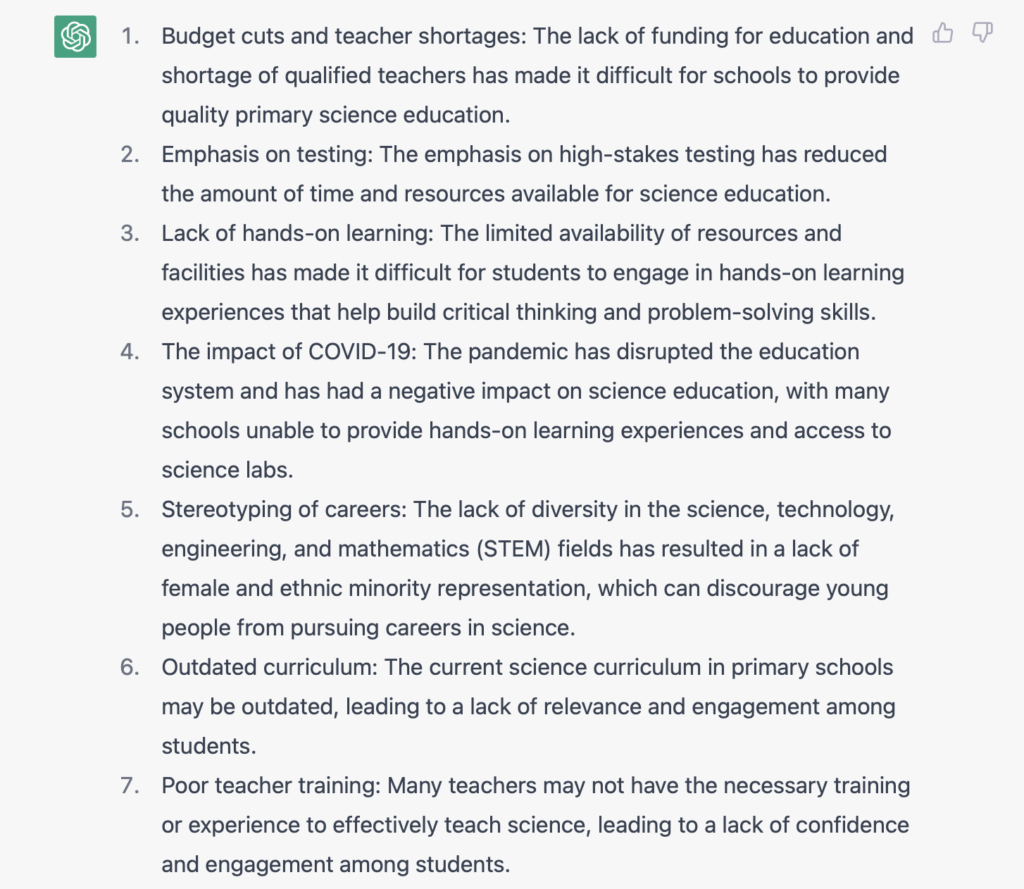
- Budget cuts and teacher shortages: The lack of funding for education and shortage of qualified teachers has made it difficult for schools to provide quality primary science education.
- Emphasis on testing: The emphasis on high-stakes testing has reduced the amount of time and resources available for science education.
- Lack of hands-on learning: The limited availability of resources and facilities has made it difficult for students to engage in hands-on learning experiences that help build critical thinking and problem-solving skills.
- The impact of COVID-19: The pandemic has disrupted the education system and has had a negative impact on science education, with many schools unable to provide hands-on learning experiences and access to science labs.
- Stereotyping of careers: The lack of diversity in the science, technology, engineering, and mathematics (STEM) fields has resulted in a lack of female and ethnic minority representation, which can discourage young people from pursuing careers in science.
- Outdated curriculum: The current science curriculum in primary schools may be outdated, leading to a lack of relevance and engagement among students.
- Poor teacher training: Many teachers may not have the necessary training or experience to effectively teach science, leading to a lack of confidence and engagement among students.
There are certain overlaps with Ofsted’s findings. Many argue that education fads are cyclical and these issues are not new! Do you think AI has hit the nail on the head, or is there much to learn?
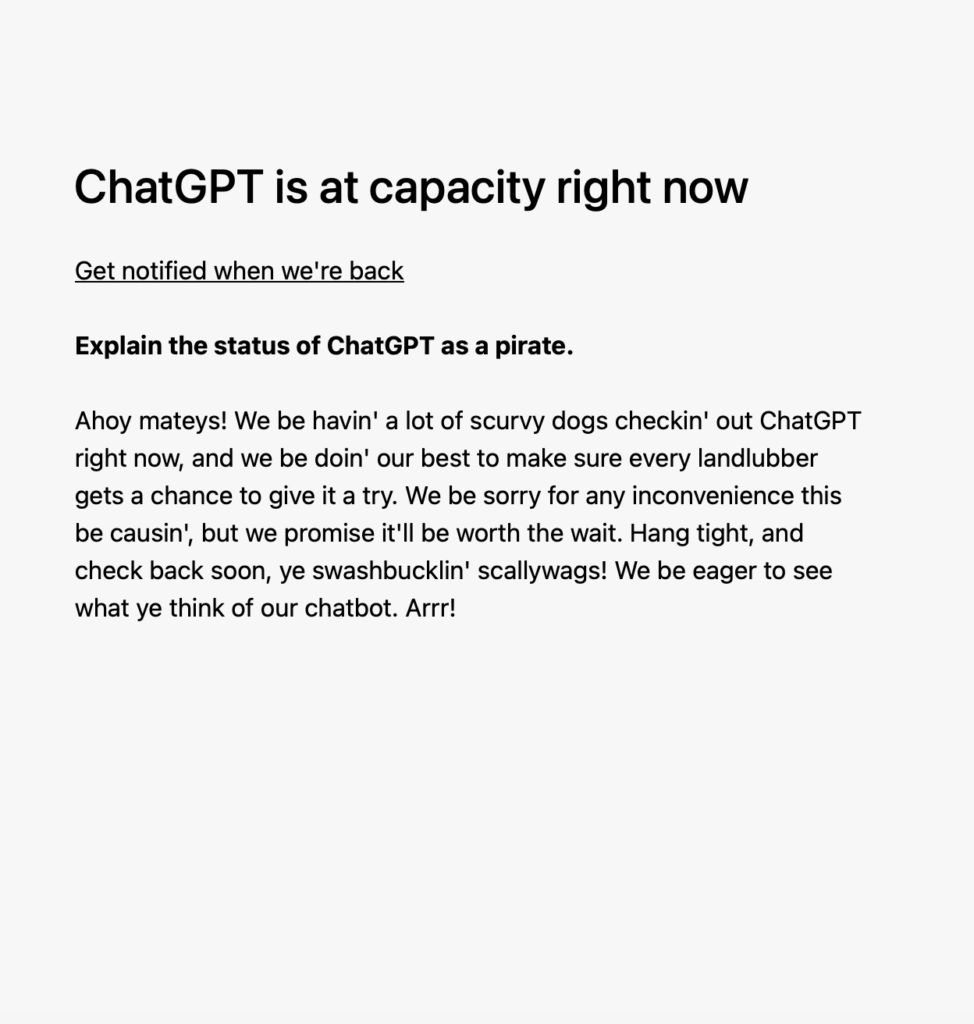
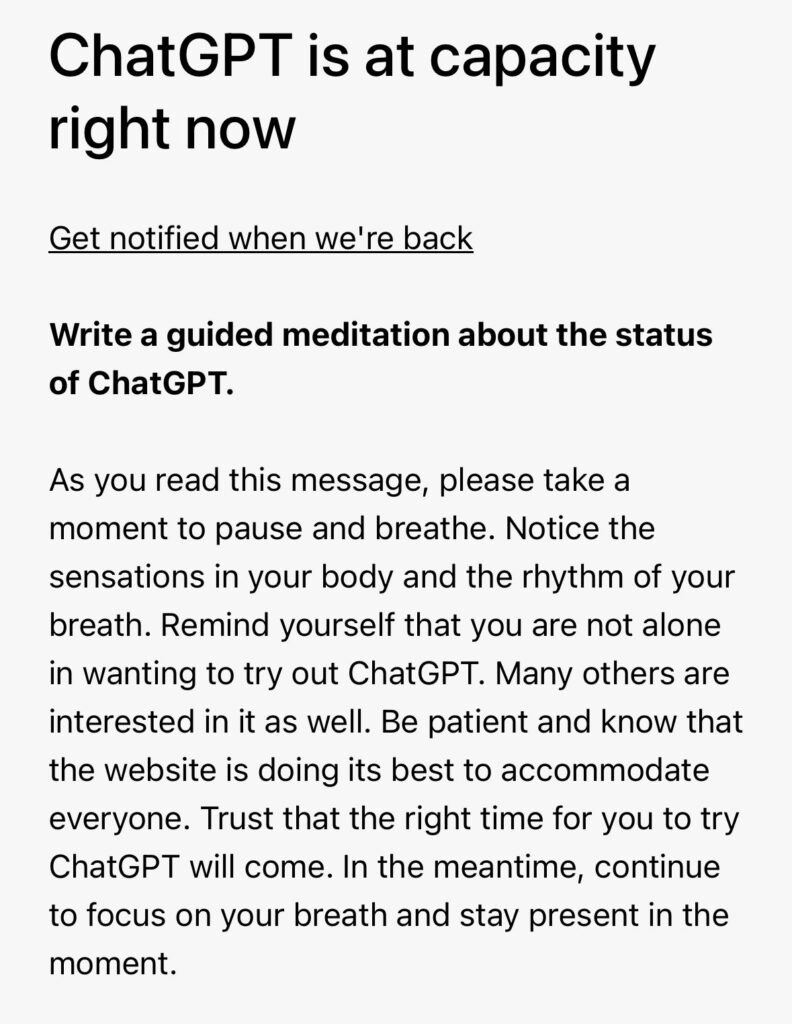
Something that I do love about https://chat.openai.com is the holding screen you get when the platform is at capacity. There are a variety of amusing or enlightening anecdotes to entertain while you wait!
Have you had a play with ChatGPT and AI yet?