
Spring is springing (as I write this today is the start of meteorological Spring) and it’s a much more inviting time to be outside. I’m currently planning an updated CPD session on working scientifically outdoors for an ENTHUSE partnership of schools (get in touch if you are interested in bespoke training) and I’m researching loads of resources to support, signpost and share for spring and summer. Of course, we can take science outdoors all year round (and I write about wintry science investigations in Teach Primary magazine) but if the warmer weather is encouraging you to take more of your science lessons outside, I’d love to share a couple of books which might interest you:

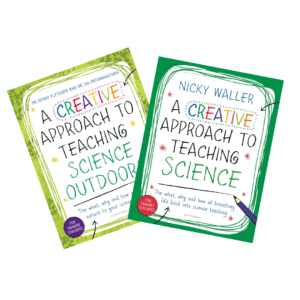
A Creative approach to teaching primary science outdoors (Bloomsbury): A review
This new book by Dr Penny Fletcher and Dr Sai Pathmanathan is jam packed full of a whopping 50 hands on activity ideas and games.
At the start of the book, there is a comprehensive grid outlining each activity’s links to the different primary science curriculum topics, as well as cross curricular links (English National Curriculum, but applicable in all 4 nations and internationally). However, it’s not linked to year group, phase, or key stage, so some work on mapping progression would be required in school.
Each activity is clearly described, with a materials list, what to do, some basic science behind it, what the children will see and what the outcome should be. And each has suggestions for links to other activities in the book to take the learning further.
These activities would also be great prompts for families and community groups wanting to explore in nature. I think it’s important to note that these are activities (sometimes investigations, games, demonstrations or explorations) not enquiries or lesson plans. These still have a role to play in the teaching and learning sequence – exploration is incredibly important for children to observe and discover scientific phenomena, link ideas and previous experiences, and many develop working scientifically skills – and many can be tweaked to answer a scientific question through enquiry (just be aware that it may take some teaching experience and skill to do so in order to avoid children remembering ‘doing an activity’ rather than the science behind it (Ofsted. Finding The Optimum: The Science Subject Report 2023). In an ideal world, we would have the time to do it all, to explore and discover through these activities and then consolidate and apply knowledge through meaningful related scientific enquiries (real world, meaningful contexts, recommended in EEF Improving Primary Science Report 2023).
The authors are experienced in public engagement, are creative science communicators and have together produced an engaging cornucopia of inspiration. Teaching Science Outdoors has a similar look and feel to other books in the A Creative Approach to… series, complementing Nicky Waller’s A Creative Approach to Teaching Science. As a teacher, Nicky has ensured that there are additional features in her book such as potential misconceptions to look out for, explicit links to the English National Curriculum statutory requirements and to the working scientifically skills, which make it much easier to fit into the teaching and learning sequence.
It is fundamental for children to be making links with the natural world, developing understanding, an interest and connection to nature; to foster empathy, nurturing, appreciation and a desire to want to protect our planet. Getting outside, supported by these engaging activities, will help to build real-life, meaningful connections.
I think the activities in this book would be great for families, enrichment activities, science clubs, and as a prompt for teaching ideas (for skilled teachers to weave into an impactful teaching and learning context). As the book blurb describes, the ’50 exciting yet refreshingly simple activities are practical, accessible and creative’. They will certainly support meaningful engagement with the natural world.
Teaching Primary Science Outdoors (Millgate House): A review
I picked up a copy of my Primary Science Quality Mark colleague, Helen Spring’s book after a hands-on and informative workshop at the Association for Science Education (ASE) annual conference in January.
As an experienced teacher and outdoor learning expert, Helen’s book provides useful tips for taking science lessons outdoors, including helpful hints, advice and resource lists. The book is divided into lesson plans, with explicit curriculum links to different topics and is super easy to slot into your teaching and learning sequences.
Both books offer heaps of inspiration, are creative and packed full of activities.
More resources
If you’re looking for further ideas for engaging with the natural world, check out these resources I have collated on Environmental and Climate Science Education and also some fab new guided enquiries from Great Science Share for Schools – Great Ocean Share , Great Observation Share and Great Sustainability Share.
I was sent a review copy of A Creative Approach To Teaching Science Outdoors #gifted. I bought Teaching Primary Science Outdoors by Helen Spring myself #notgifted.