
Whilst any time is a good time for doing science, the dark evenings at this time of year and spooky feel of Halloween lends itself so well to some themed investigations: From witches’ potions to spooky slime, there are lot of opportunities to get stuck in!
This year more than ever, when halloween doesn’t look quite the same as in normal times, here are a few investigations to make Halloween a little bit special!
Dry Ice investigations
Dry ice is a great way to set a spooky mood, and there is a whole heap of science involved: dry ice is, in fact, the solid state of carbon dioxide. Carbon dioxide, or CO2, normally exists as a gas at room temperature and pressure. Most materials can exist in three states: solid, liquid, or gas, depending on the temperature (and pressure) and their relative melting/boiling points. Carbon dioxide, however, tends only to exist in two: solid and gaseous; and it undergoes sublimation (or it sublimes) to go directly from a solid to a gas, without passing through the intermediate liquid phase as it warms up.
As CO2 is more dense than air, it sinks as it is produced and can be seen billowing across surfaces, eliciting that eerie effect.
Most of us don’t routinely have access to dry ice*, however, but there are other CO2 investigations which we can easily carry out at home.
*Dry ice is available, with appropriate risk assessments (solid CO2 is very, very cold (about -80°C), from suppliers such as chillistick.com
Acid and Alkali reactions – Fizzing potions
Carbon dioxide gas is produced during a chemical reaction between an acid and an alkali and can be seen as bubbles.
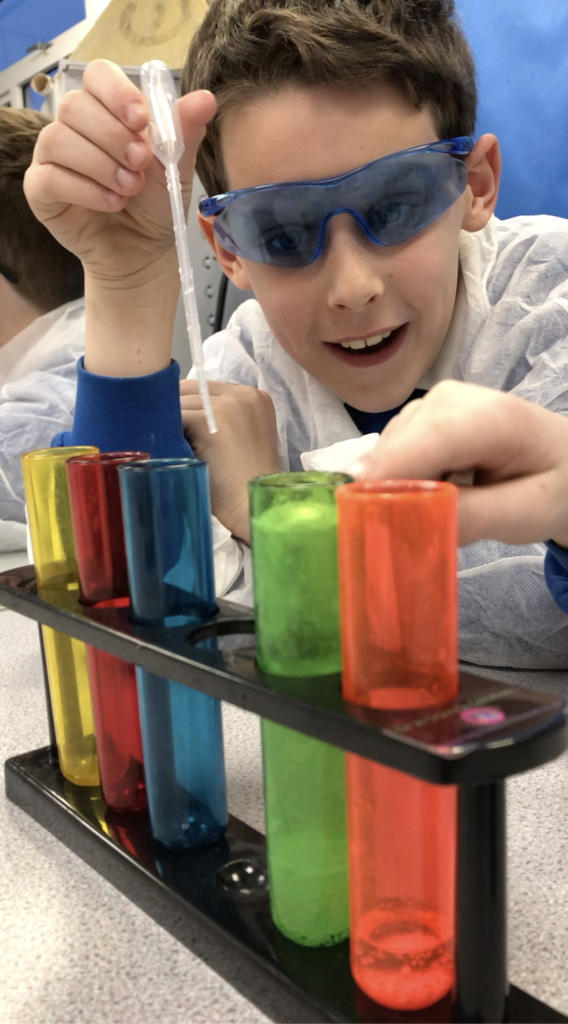
This can easily be carried out at home using the vinegar (acid) and sodium bicarbonate (alkali) reaction. This reaction is great for creating spooky potions at halloween. You could add food colouring to increase the Halloween feel, or capture the CO2 to inflate a balloon in this floating ghost activity:


Or to power an effervescent popping rocket.
or even to explode a pumpkin monster (do this one outside and stand well back!)

Spooky Slime
Another halloween favourite is making slime. There are many slime recipes about, from the slightly contentious sodium tetraborate-containing varieties* to the basic cornflour and water oobleck, or gloop. The messy, gooey, perplexing non-newtonian fluid is fascinating and fun – exhibiting properties of both solids and liquids simultaneously: It pours like a liquid but when constant pressure is applied it behaves like a solid.
*borax is toxic, especially in its powder form if ingested and can also cause skin irritations. If using then take extreme care, follow instructions, with supervision, avoid touching the face and contact with cuts and abrasions, and wash hands well after handling.

More Halloween science fun
You can find even more spooky Halloween science activities with #DrJoScience’s #SpookyScienceSpecial science club or virtual workshop with video demos and a bumper activity pack containing 16 different spooky investigations!

- Here’s some more Halloween themed science with my pumpkin marshmallow jack-o-lantern take on the vacuum pot activity available from The Curiosity Box.
As you pump the air out, the pressure on the marshmallow reduces, allowing the air inside the marshmallow to expand, or push out. This increases the size of the marshmallow, but the effect is perhaps even more striking when the vacuum is released, air pressure returns to normal and the marshmallow rapidly shrinks back down!
You can also find a bumper pack of Spooky Science Activity prompts and ideas for FREE in my TES resources shop.
Safety First
Please remember to be safe and minimise any risks. Think carefully before you do any experiments. You are responsible for your and your children’s safety.
#NotSponsored #SpookyScienceSpecial #HalloweenScience #Halloween #Potions #FizzingPotions #DrJoScience #BeCurious