

Although the changing seasons are marked by the changing colour and dropping of leaves (more on this in a future blog post!), it’s still summer and yet many leaves are already turning brown…
There are actually a few reasons why leaves may turn brown, especially in the horse chestnut (conker) tree.
Leaf blotch
A fungus, Phyllosticta paviae (syn. Guignardia aesculi), causes Horse Chestnut leaf blotch – irregular patches of brown on the leaves, sometimes with yellow edges, usually during summer. Severe attacks can cause the leaves to shrivel completely. Leaf blotch isn’t usually seriously damaging, despite looking unsightly.
Leaf Mining moth
Something I’ve spotted a lot more of lately is not leaf blotch, however, but smaller brown lesions, usually sitting between two lateral leaf veins – so often more elongated in shape – which are caused by the horse chestnut leaf mining moth larvae (Cameraria ohridella). It has spread widely in England since 2002 (RHS) and the effect on leaves in late summer can be quite dramatic! Due to the damage to leaves, the plant may have a reduced ability to photosynthesise and this could impact energy stores and resources. Although trees may drop their leaves early, the leaf miner blotches don’t seem to have much effect on the health or growth rate of trees but may affect developing conkers.


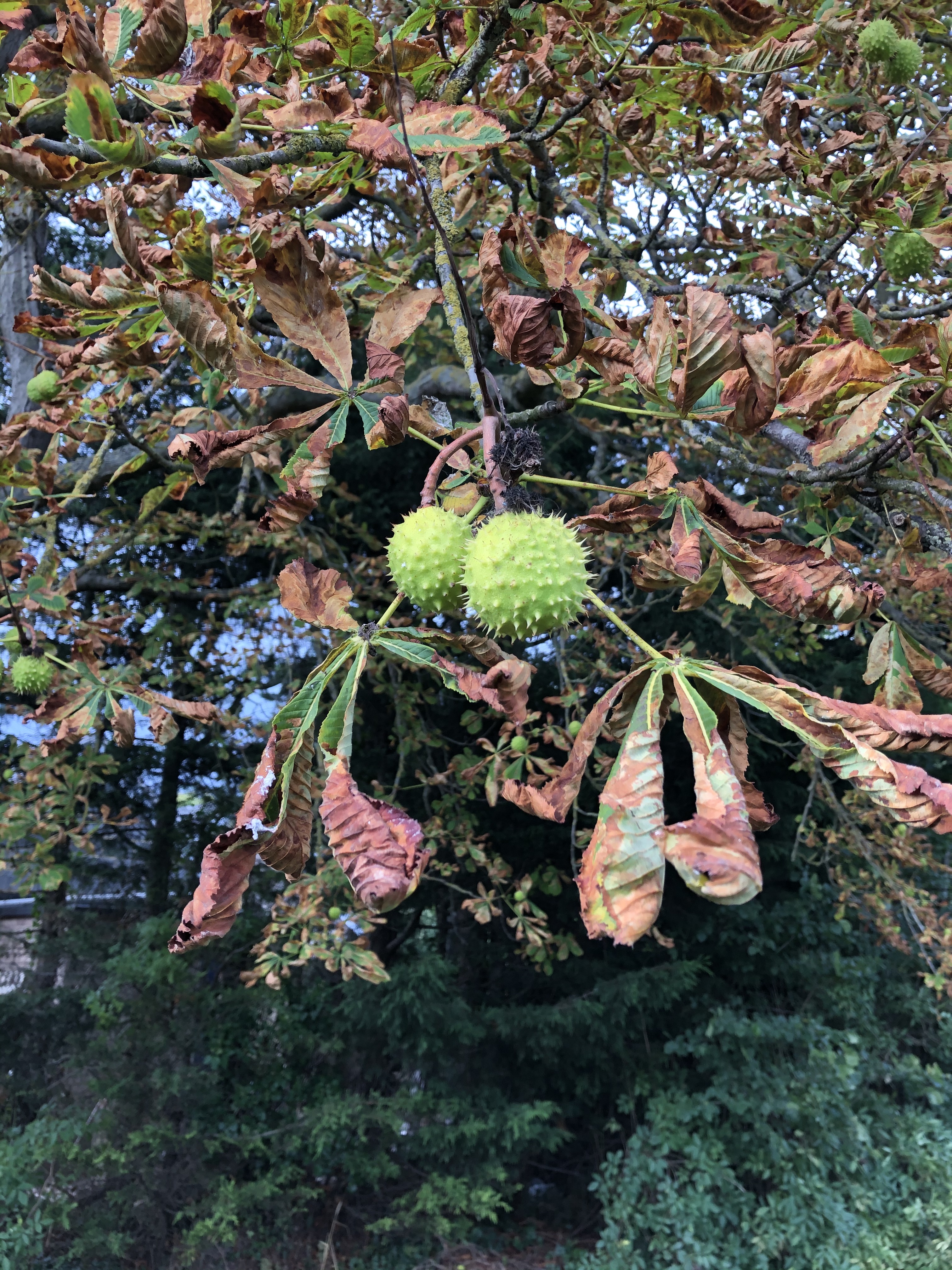

The Horse chestnut leaf mining moth larva lives between the top and bottom surfaces of the leaf, so it is hidden and protected from potential predators and can feed undisturbed. The small blotches are pale when they first appear between the leaf veins but turn brown as summer progresses. You can peel the top layer of the leaf away and reveal the larva (caterpillar) hiding beneath:

There may be several generations of horse chestnut leaf mining moth during a summer. The adult moths lay eggs on the surface of the leaf and the caterpillars then hatch and burrow under the surface to feed. The moth can overwinter in the leaves as pupae and so collecting and burning the leaves may help to stop the spread.
There is a citizen science project (conkertreescience.com) finding out more about the horse chestnut leaf mining moth and scientists are also looking at ways of controlling the pests with biological control – using other insects to control the population.
Caterpillars
Of course, caterpillars (and other animals) often feed on leaves and we are all familiar with leaves with holes in like these (gardeners especially!).

The caterpillar ate through one nice green leaf, and after that he felt much better
The Very Hungry Caterpillar, Eric Carle
You can also see evidence of caterpillar feeding on leaves with these tracks or mines left by moth larvae of the stigmella genus:


Brown leaf edges
You may also spot leaves with brown edges. This could be due to drought stress, but there’s also an unknown condition affecting horse chestnuts resembling this too.

These maple leaves have brown edges, which could be maple leaf scorch, caused by drought stress.

One of my science clubbers recently sent me some photographs of some thirsty acer leaves that they managed to rescue this summer:


Galls
Other evidence of insect damage to leaves are galls, including (left to right) the acalitus gall mite, the red gall mite on sycamore leaves and the characteristic circular dots on oak leaves caused by the common spangle gall moth.


Fungus
Fungi may also be evident on leaves, including the black tar spot (Rhytisma acerinum) on sycamore or maple leaves in later summer and autumn. This is a minor, localised infection which doesn’t cause long term issues for the tree.

Turning Brown
These are just a few incidences of the many plant pests, pathogens and disease which afflict trees and leaves. Damaged leaves or stems could also lead to the leaf tissue dying and turning brown. This is different to the slow change of colour and eventual dropping of leaves we will soon see in deciduous trees in the autumn (more on that later). Autumn is on its way, but not quite yet!
#Plants #PlantBiology #PlantScience #PlantDiseases #Pests #Pathogens #SeasonalChanges #Seasons #Trees #Insects #Leaves #Leaf #Moth #Butterfly #Larva #Larvae #Lepidoptera #Caterpillar #Fungi #Galls #Mites
Super discourse here on all things affecting horse chestnuts. Those near to us (South Manchester area) seem to be coping, despite the leaf miner, no sign of turning brown yet this year.
Thank you.
Has the very hot dry weather this year trucked my horse chestnut into thinking it’s later in the year than it is , because it’s lost so many leaves so early big little evidence of infestation or disease
We have noticed extensive evidence of the mining by cameraria ohridella here in our garden. ( In the Irish midlands) Is it known in Ireland? I shall inform our county wildlife officer tomorrow, Máire
Two things I am noticing about my horse chestnut which are puzzling. The first is the leaves turning brown which starts out as spots then the whole leaf in late summer. The second is that it appears really healthy in the Spring and has numerous flowers followed by tiny chestnuts which form & then they fall to the ground. The tree is otherwise very healthy looking. What are your thoughts on this?
Chesnut young tree in a very small woods, only chesnut there, looks exactly like leaf minor moth problem. Within 2 weeks the whole tree is covered. Last year bc I love this tree so much and as its so young and the only one I clipped the branches and leaves not knowing that it was a moth. Thinking the tree had a chance, but this year same thing, though the tree has grown quite a lot
I have a chestnut tree just plated it and know 1 mount later the leaves are turning brown on the edges what can I do to save it