For me, it’s a mixture of all 3. Let me tell you why…
As we head back to school for a new school year still dealing with the covid-19 pandemic but with lifting restrictions in the UK, there are mixed feelings about a return to in-person teaching. Whilst there is joy to rekindle connections and community, there’s also a debate about safety. Many organisations are still maintaining remote working, social distancing, masks and reduced occupancy in offices, but it’s business as usual back in school. For me as a consultant working across multiple schools, I still have a duty of care to ensure I’m not a super spreader.
I wrote this blog post last year to document a new way of working for science education, and it’s becoming a longer term change in the way I work. The blog post first appeared on Science On A Postcard’s blog in May 2020 (now Little Science Co).
Face to face, but safety first
As I return to working face to face with lots of schools, I’m putting a number of practices in place to minimise the risks to others as well as myself: I’m double vaccinated and carrying out lateral flow tests before in-person events, I’m only visiting a maximum of two schools each week – well spread out – I’m still quarantining and carrying out extra cleaning on equipment and resources, wearing a mask in busy communal areas, reducing group sizes and keeping my distance as much as possible. I’m following the latest health and safety advice from CLEAPSS and being sensible. As we head back to school after a summer of increased mixing and travelling, cases of coronavirus are inevitably going to increase again and I want to play my part in not mixing that between different school communities.

Virtual delivery
I’m still carrying out the majority of my bookings virtually this term while we see what happens. All of my teacher professional development sessions will be delivered online, and I’m still teaching (around the country and the world) virtually. My hands-on workshops are just as popular delivered remotely. All workshops use either easy to find household items, or I can send kit to schools to use in the UK.
The opportunities enabled by remote learning have increased my reach which means I can inspire students anywhere, not just in my local area. And that’s actually been a fabulous thing – for me and for them. It also means I can visit more schools each week, popping in for just one lesson, a regular weekly slot or even a whole day.
Virtual or Online
Since March 2020, the world has experienced a massive learning curve in remote education. More people are now aware of the differences between virtual (live and interactive, but remote) and online (prerecorded) courses, and synchronous and asynchronous delivery. As well as my in person and virtual workshops, I also have a number of online and digital resources to download and access at a time to suit you.
Accessible and Inclusive
Having virtual and online options also means that I can increase the inclusivity and accessibility of what I provide, to include more people, not just around the world, but also people who couldn’t otherwise be involved. I can also include text for screen readers, or subtitles for those with hearing difficulties. It’s a win-win situation!

Free stuff!
I’ve also been creating lots of free stuff to help support science teaching and learning, including:
- Science Activities
- Children’s University
- I provided free online workshops for schools whose bubbles burst in the last weeks of term, reaching more than 1000 pupils
- Advice and support for teachers on social media
- Weekly science facts on twitter, Facebook and instagram
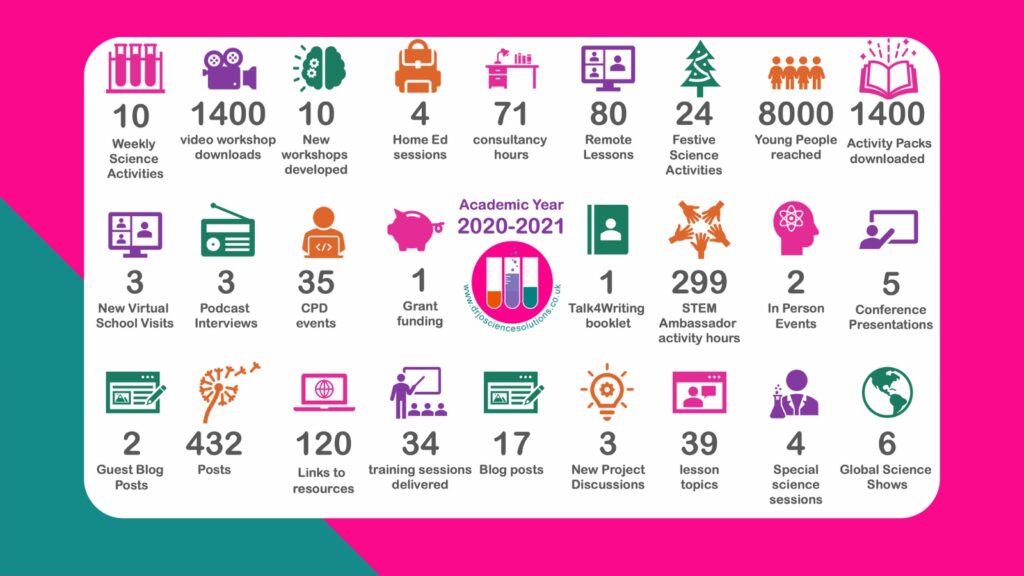
At the start of a(nother) slightly uncertain new school year, I like to reflect on last year’s achievements in the midst of a global pandemic and know that I’m prepared for the ride ahead!